
1. Surface effect warps electric field in cuvettes
 The liquid surface inside a cuvette is curved because of a small liquid-solid contact angle. The curvature alters the even distribution of voltage. The voltage distribution in the liquid can be simulated by a simplified equivalent circuit. The whole liquid is subdivided into resistors of roughly identical resistance. These resistors are connected into multiple series with the same end-to-end total voltage between the electrodes and the series are also arranged in parallel. In a series circuit, voltage is distributed in proportion to resistance. Each of these resistors would have the same voltage if the liquid surface is flat.
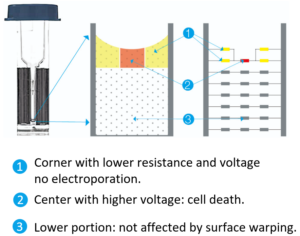 At the liquid corner (
 ), two resistors are first connected in parallel with the resistance cut in half and they are then connected in series to the center resistor (
  ). The corner resisters assume a lower voltage and the cells in the corners are insufficiently electroporated ( ). The center resistor is allocated a higher voltage and the cells in the center under the curved surface are killed by an excessive voltage ( ). Therefore the upper portion in the cuvette is a poor area for electroporation. Only the lower portion (
  ) is the good electroporation area unaffected by the surface warping effect.
2. Bubbles cause current turmoil in cuvettes
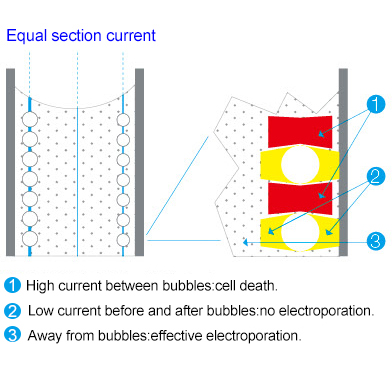 The electrode surface is quite large in cuvettes. Electrochemical reactions produce toxic agents and air bubbles. The bubbles are a huge adverse factor in electroporation. The bubbles are insulators and the electric current has to flow between the bubbles. The space between the bubbles thus has a higher current and the cells in this area are killed ( ). A bubble warps the electric current similar to the insulator cell shown in Electroporation Mechanism. On the direction of total current, areas before and after the bubble ( ) have a lower current and cells in these areas are not effectively electroporated. Only the middle portion of the liquid ( ) away from the electrodes is the optimal area.
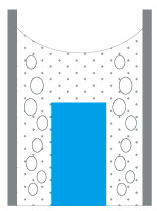
Summary: Limitation of cuvettes
Within the cuvette, the upper portion is a poor area for electroporation as well as the two side portions adjacent to the electrodes. After cutting out the poor areas, the real optimal area (shown as the blue block at the right) in the cuvette is small. For 1mm and 2mm cuvettes, there might be no optimal area at all since the bubbles can spread from the electrodes quite vigorously.