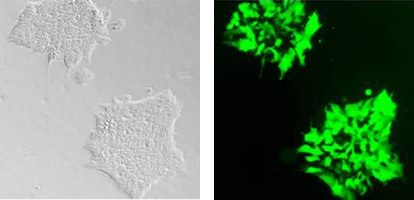
Overcoming Delivery Challenges in Pluripotent Stem Cells
Human induced pluripotent stem cells (iPSCs) are notoriously sensitive to high-voltage stress and traditional chemical transfection methods. Celetrix’s specialized electroporation technology preserves high cell viability while achieving exceptional transient and stable delivery rates.
Published Research & Scientific Applications
 Johns Hopkins University School of Medicine (Disease Modeling): Researchers successfully generated and characterized human homozygous SCA12 iPSC lines (such as line JHUi003-A) utilizing Celetrix electroporation systems.
Scientific Reports (Nature Publishing Group) (CRISPR & HDR Enhancement): Studies demonstrate that combining Celetrix electroporation with transient BCL-XL overexpression and single-guided Cas9 nickase (Cas9n) significantly boosts post-transfection cell survival and achieves high-efficiency homology-directed repair (HDR) in human pluripotent stem cells.
Pluripotency Preservation: Gene-edited iPSCs maintain normal chromosomal karyotypes, strongly express classic markers (e.g., Oct4A, Sox2, Nanog, SSEA4, TRA-1-60), and retain full multi-lineage differentiation capacity.
For CRISPR knockout in iPSCs, see our iPSC gene editing protocol (Cas9 RNP).